The Ankle Gearbox: metaphor or mechanical reality?
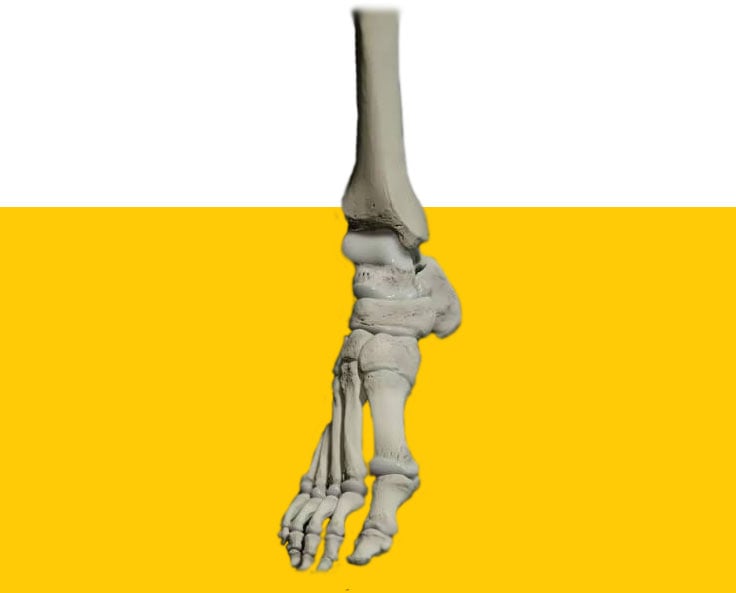
What if the talus in the ankle has more than one mechanical gear?
The notion that our ankle joints operate much like an automotive gearbox isn't exactly groundbreaking. Just look at the 2008 paper, Transmissions within the Tarsal Gearbox.
But here at Vitality Audit, we've gathered data that takes our understanding of this mechanism to the next level.
Our task was to determine, using computational modeling, whether the ankle's talar block—specifically, its anatomy—can change the system's mechanical advantage. A yes would confirm that the ankle has the necessary attributes to mechanically shift between gear ratios.
The answer came back yes.
A geometric model—built from published 3D measurements of the talar block—revealed that the curvature of the trochlea tali can generate differences in mechanical advantage of up to ~45%. More importantly, in our model, movement along this curvature enables reversible shifting between force-optimized and speed-optimized mechanical modes.
This doesn't mean the talus is literally an "anatomical gear." What's really important to us is this: the talus's geometry—which is unusual for a typical joint—creates the mechanical conditions for it to function not just as a passive hinge that rotates under muscle action, but as a potential multi-mode transmission mechanism for the leg, whether in standing or in motion.
These findings let us introduce a new mechanical lens to our posture and gait audit protocol.